
The Last House
Claustrophobic Dread Meets Human Resiliency
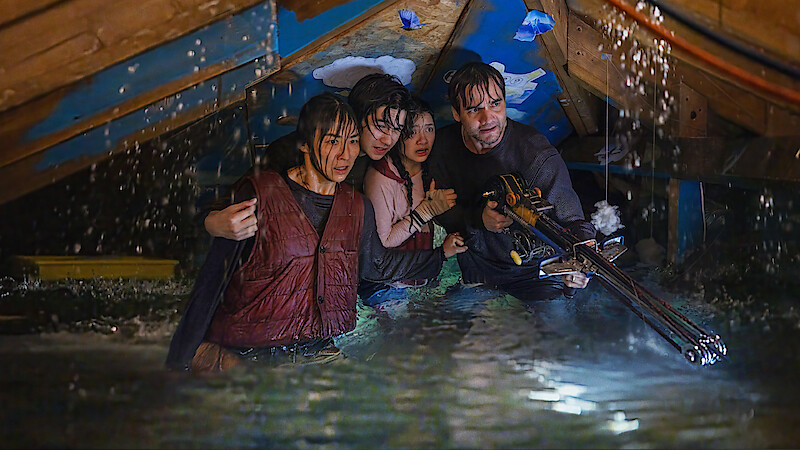
Directed by Louis Leterrier, The Last House is a high-concept sci-fi survival thriller that trades grand cosmic battles for intense domestic peril. Starring Wagner Moura and Greta Lee, the film focuses on the psychological toll of an unprecedented global catastrophe. Instead of taking us across vast post-apocalyptic landscapes, The Last House traps us inside a suburban Seattle home where a family is inexplicably sealed off from the outside world as a mysterious apocalyptic threat devastates the planet.
The Plot: Domestic Isolation in an Ending World
The story follows Jason Delgado (Wagner Moura), an engineer struggling with unemployment, his wife Ann (Greta Lee), and their two young children. What begins as an unusually dark, looming storm quickly morphs into a localized nightmare when an unseen force seals their home. Communication drops, power flickers, and every door or window leads into an incomprehensible void of deadly atmospheric pressure.
As days stretch into weeks, the film transforms into a survival masterclass. Jason constructs improvised water filtration systems while Ann manages indoor crop cultivation. The horror does not stem from blood and gore, but from the relentless ticking clock of dwindling resources and the agonizing question of what has happened to humanity.
Performances: Moura and Lee Drive the Emotional Core
Wagner Moura delivers a profoundly grounded performance as Jason. He balances the pragmatic, problem-solving mindset of an engineer with the quiet terror of a father who knows he cannot protect his family from the unknown. Moura’s eyes convey a desperate fatigue that gives the film its emotional weight.
Opposite him, Greta Lee is phenomenal as Ann. She rejects the typical “hysterical mother” tropes often seen in disaster films, playing Ann as a sharp, pragmatic force of nature who keeps her children grounded through routine and hope. The subtle, non-verbal moments between Moura and Lee—shared glances in the dark, silent conversations over meager food rations—anchor the movie’s high-concept sci-fi premised in believable human drama.
Direction and Visuals: Tight Spaces and Suffocating Tension
Louis Leterrier, known for big-budget action like Fast X and Now You See Me, demonstrates impressive restraint here. He uses wide-angle lenses inside tight rooms to make the familiar, cozy domestic setting feel terrifyingly small. The lighting evolves along with the family’s situation: warm, natural sunlight gives way to stark battery-powered lanterns and shadows. The sound design relies heavily on eerie silence punctuated by unsettling thumps from outside the walls.
While the film suffers from a slightly sluggish middle act where the survival routines repeat themselves, its third act delivers a nerve-wracking, high-stakes conclusion. It forces the characters to make impossible moral choices to secure their freedom.
The Verdict
The Last House is a haunting exploration of human endurance, love, and isolation. It might lack the CGI spectacle of typical alien invasion blockbusters, but its intimate focus on a single family makes the stakes feel infinitely higher.
- Where to watch it? Stream on Netflix